
Twelve pillars to take back the controls of a life that works… and no longer looks like you.
Six weeks · workshops Tuesday and Thursday evenings, online
No drama on the horizon. The career holds up, the people around you find you solid, and from the outside there is nothing to fault.
Except you wake up on a Tuesday morning and wonder whose life this is. You are very good at things you never really chose. You are efficient in a direction you never decided on.
“I don’t know why I keep doing all this anymore. It doesn’t mean anything, I have lost myself.”
I hear that sentence every week. Almost always from people who are succeeding.
A plane on autopilot does not fall out of the sky. It keeps going, exactly on the heading it was given a long time ago — a heading chosen by other people’s expectations, by what felt reassuring at twenty-five, by what seemed compulsory back then.
The autopilot does its job well. It simply has no idea where you want to go today. And nobody ever showed you how to take back the yoke.
Now the good news: this can be learned. It is not inspiration, and it is not motivation that fades. It is a procedure, with proven tools, and you practise it.
Seeing where the current heading came from, and who actually chose it.
Changing the perspective you look at your life and your options from.
Setting the new heading deep enough that it holds when the week gets hard.
Twelve 60-minute online workshops, twice a week, Tuesday and Thursday evenings. One pillar per workshop.
Six one-to-one sessions of 30 to 40 minutes, running in parallel, to apply each pillar to your own life.
Six weeks in total. It is short, and that is deliberate: two appointments a week is part of the work. There is no time to slip back into autopilot between workshops.
Before we talk about a destination, we need to know where you are starting from. There are five possible seats, and each one calls for a different first manoeuvre.
In the cargo hold
You are carrying so much baggage the aircraft cannot climb. That is the past.
In the passenger seat
You go with the flow and watch the parade go by. A spectator of your own life.
In the co-pilot’s seat
Somebody else is steering: a boss, a partner, a friendship, an expectation.
Captain, but on autopilot
You are flying, technically. You are not piloting.
On the ground, in the hangar
Held still by fear, without even attempting takeoff.
Most of the people I work with recognize themselves immediately. And almost nobody is in the seat they thought they were in.
A pillar is not something you get past: it is something you set down. Each one holds up part of the structure, and it is the whole that carries the weight. One workshop per pillar, twelve workshops in six weeks.
1. The autopilot
Unmasking the conditioning. The 4 C audit: repeated Conduct, Consciousness, Conditioning, Choice.
2. The obstacles
The limiting beliefs and the stories you tell yourself without hearing them.
3. The captain
Taking back the controls. Making peace with the past — because you do not take off with an overflowing hold.
4. The pilot’s licence
Flying consciously. You are not only the pilot: you are the plane.
5. The flight instruments
Presence, clarity, values. Getting out of your head and back to the controls.
6. Identity
Your “I am” is your main instrument. Consciously defining who you choose to be.
7. The black box
Decoding the energy and the core needs that actually drive your choices.
8. The flight plan
The heading, the milestones, the deadlines. Without a clear destination, circumstances do the flying.
9. The takeoff procedure
Taking action. Taking off is not a leap into the void: it is a procedure.
10. Cruising speed
Holding the heading over time, when the excitement fades and the old autopilot comes back.
11. The optimization tools
Fuel, recovery, filtering. Maintaining the most precious aircraft of all: your body.
12. The maintenance manual
Best practices, day to day. Transformation is not a summit, it is a practice.
The first eight pillars happen on the ground. That is the preparation: the audit, the obstacles, the licence, the instruments, identity, needs, the flight plan. You check, you adjust, you plan.
The ninth is the moment the aircraft leaves the runway.
And here is what I teach there, because that is where almost everyone gets stuck: you never feel ready. A pilot does not take off out of courage, a pilot runs a procedure. The fear stays. The checklist does not change.
The last three pillars are there to hold the heading once you are in the air — because the old autopilot knows the way home by heart.
Between what happens to you and what you do, there is a chain. Reality, then what you perceive of it, then the story you tell yourself, then your invisible rules, your values, your beliefs, the emotion it triggers, the choice you make, the behaviour, and at the end: your trajectory.
Ten links. Most of the time the chain runs by itself and you only see the two ends — what happened, and what you did. The work consists of making the eight in the middle visible. Because you cannot change what you cannot see.
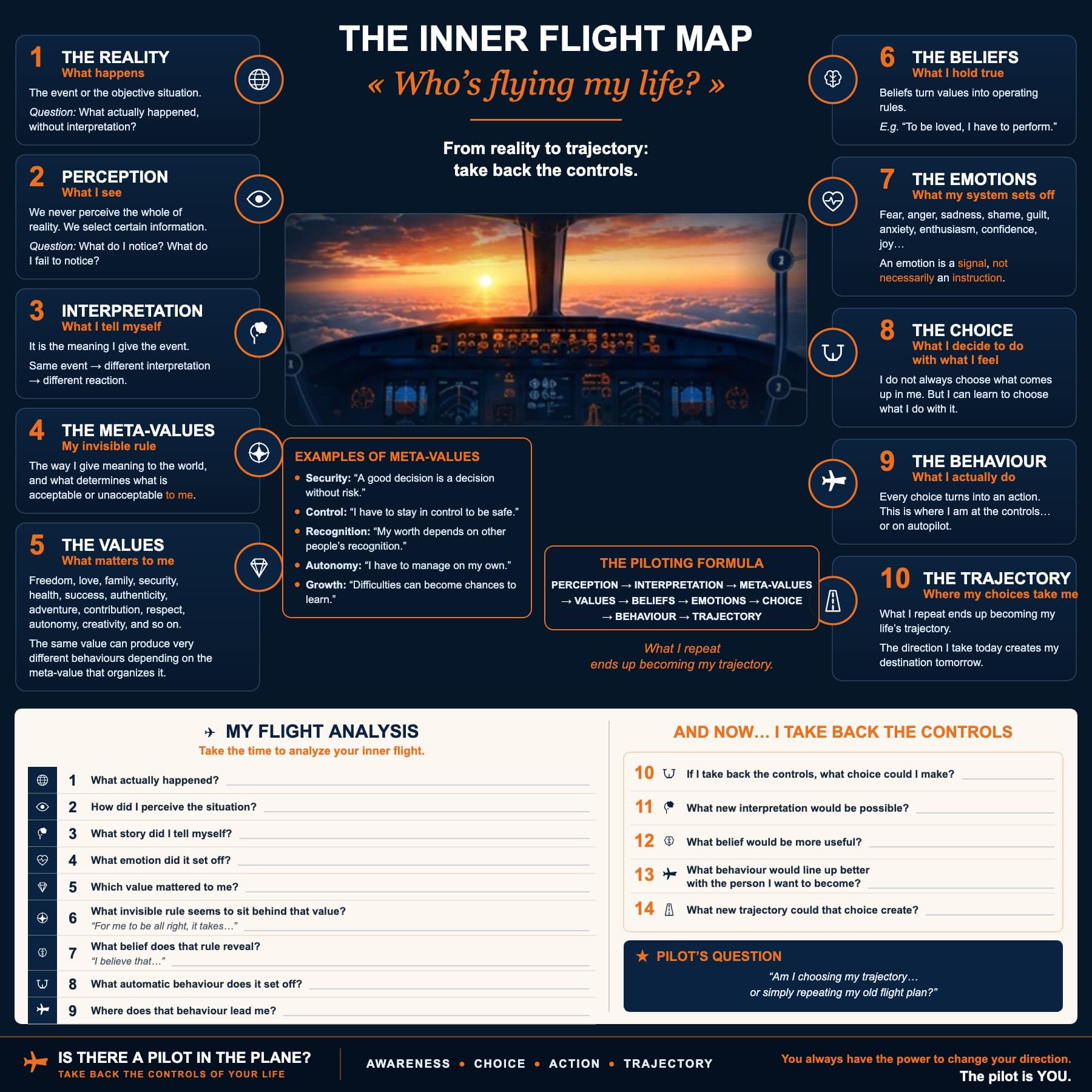
Click the map to enlarge it.
This map is the central instrument of the program. We use it from the very first pillars, and we come back to it every time a situation makes you react in a way you do not understand.
“Am I choosing my trajectory… or simply repeating my old flight plan?”
“Regain the Power of Choice” is the way in, and this program is for those who have completed it. There is a simple reason for that: as long as a compulsive habit is at the wheel, choosing a direction does not get you very far. The autopilot takes back control come Tuesday night.
There is one exception, and I keep it deliberately. Sometimes a person has no compulsive behaviour to undo, and the only real question is the one about direction. In that case I can authorize direct enrolment — after the assessment call, never before.
That is exactly what the call is for: to look at where you are, and tell you honestly where to start.
Thirty minutes on the phone, free and with no obligation. You tell me where you are, and I tell you honestly where to start — even if the answer is neither of my programs.
Is there a pilot in the plane? Yes. It is you.
© 2026 Coaching Patrice Beaudoin — coach en potentiel humain à Montréal
Anciennement Maison La Bouée · Politique de confidentialité